Two Setups, Two Operating Roles
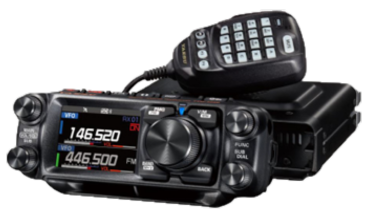
My VHF/UHF mobile setup is a Yaesu FTM-500DR with a Comet CA-2X4SR antenna. For HF, I use a Yaesu FT-891 paired with a Yaesu ATAS-120A. The FT-891 also doubles as my Parks On the Air (POTA) radio.
| Operating Role | Radio | Antenna | What This Adds |
|---|---|---|---|
| VHF/UHF mobile | Yaesu FTM-500DR | Comet CA-2X4SR | Local and regional FM/C4FM operation through suitable repeaters or simplex contacts. |
| HF mobile | Yaesu FT-891 | Yaesu ATAS-120A | HF operation with a compatible motorized tuning antenna. |
| Parked portable / POTA | The same FT-891 | Chosen for the deployment | A portable operating role for the radio, with power, antenna support and logging planned for the site. |
These are separate operating subjects alongside the home SDR station. The radio/antenna pairings are confirmed; vehicle model, mounts, cable routing, power wiring and the particular antenna used on each POTA outing are not assumed here.
VHF/UHF: FTM-500DR and Comet CA-2X4SR
Product information and manuals ↗
Product photograph: Yaesu UK ↗
Product information and manuals ↗
Product photograph: Comet ↗
View FTM-500 Control-Head Adjustment Details
The FTM-500DR is Yaesu’s 144/430 MHz FM and C4FM mobile transceiver. Its detachable control head, dual-band reception and memory organization support a practical local operating position. C4FM/System Fusion and D-STAR are different digital-voice systems; this is not the same path as the Kenwood/ZUMspot setup.
The Comet CA-2X4SR is the antenna used with it at W3UJ. Comet lists the standard version with a PL-259 connector and a fold-over hinge; the NMO version is a separate model. Match the actual antenna base and mount rather than treating those versions as interchangeable.
Mount location, nearby metal, feedline loss and surrounding terrain affect performance. Check the installed antenna on both intended bands. An antenna’s broad published coverage does not expand the radio’s amateur-service transmit authorization.
FTM-500DR specifications and manuals ↗ · Comet CA-2X4SR reference ↗ · Explore the separate D-STAR setup →
HF Mobile: FT-891 and ATAS-120A
Product information and manuals ↗
Product photograph: Yaesu UK ↗
Product information and manuals ↗
Product photograph: DX Engineering ↗
The compact FT-891 supplies the HF operating position. Its ATAS support controls the compatible ATAS-120A Active Tuning Antenna System, whose internal motor changes the antenna’s physical tuning. This differs from a separate tuner matching an otherwise unchanged antenna.
Control travels through the coax, so follow Yaesu’s complete connection and setup instructions. Do not assume an inserted switch, adapter or other inline device passes the required DC/control path. Select the specified ATAS mode on the radio and follow the manual’s initialization/tuning procedure before evaluating performance.
The antenna does not cover every band the FT-891 can transmit on. Consult its published band list and mode/duty-cycle limits; do not treat the FT-891’s maximum power as an appropriate setting for every antenna or digital-mode session.
The installation matters: the mount must support the antenna mechanically and provide the RF connection required by the antenna instructions. A good DC continuity reading alone does not establish an effective RF ground. If tuning fails, inspect the mount, bonding, coax, connectors and setup before repeatedly forcing a tune cycle.
FT-891 product page and manuals ↗ · ATAS-120A specifications and operating limits ↗
One FT-891, Another Role: POTA
My FT-891 also serves as my POTA radio. Parks On the Air connects activators operating from eligible parks with hunters contacting them. The radio can be reused, but the field deployment needs its own power and antenna plan.
For a parked or portable session, identify the power source, expected operating time, antenna, feedline, supports and logging method. An ATAS installed on a vehicle and a whip placed on a tripod are not automatically equivalent: verify the intended mount and RF return arrangement for whichever antenna is deployed.
W3UJ’s portable mast and tripod references and whip, feedpoint and loading-coil discussion help plan other deployments. They do not establish that every listed accessory is used with the FT-891 on every outing.
Check the current park listing, boundaries, access rules and program requirements before activating. Keep a useful log and follow the official submission guidance. Set up clear of paths and other visitors; leave the site as you found it.
POTA parks, activity and spotting ↗ · Official POTA rules and getting-started guides ↗
Build a Dependable Mobile Installation
- Power: follow each radio manual and the vehicle manufacturer’s guidance for supply connection, fuse placement, cable size and return routing. Plan for the combined load if both radios can transmit; do not assume an accessory socket is suitable.
- Mounting: secure radio bodies, heads and microphones without obstructing controls, sightlines, airbags or passenger space. Preserve cooling airflow.
- Antennas and coax: verify mount strength, vehicle clearance, strain relief, weather protection and cable routes that avoid pinching or abrasion. Fold or remove antennas as the manufacturer permits before entering low-clearance spaces.
- Bonding and noise: distinguish DC power return from RF bonding. Compare receiver noise with the engine and accessories off and on while parked, then trace individual sources. Use appropriate common-mode suppression where needed.
- Two radios: account for antenna separation and transmitter energy reaching the other receiver. Separate antennas do not automatically guarantee adequate isolation. These vehicle installations are not represented as using the home SDR Switch chain.
- Operate deliberately: complete programming, tuning, troubleshooting and logging while safely parked. Keep controls simple and observe applicable driving and radio-use requirements.
Common-mode RF guidance → · Read forward power, reflected power and SWR →
A Parked Checkout Before the Next Outing
- Confirm the correct antenna is connected to each radio and inspect the mounts and feedlines.
- Check power connections and supply behavior during a brief, appropriate low-power test.
- Verify the VHF/UHF installation on the bands and channels you intend to use.
- Complete the FT-891/ATAS setup and tune sequence according to Yaesu, then check the selected band before increasing power.
- Compare noise with vehicle electrical systems off and on; investigate changes one source at a time.
- For POTA, check the park, operating plan, battery provision and logging method before leaving.
Record the settings and results that work. A low SWR is useful evidence of a match at the measurement point, not proof of antenna efficiency or freedom from interference.